Are Acoustic Neuromas Cancerous? Understanding Acoustic Neuromas and Cancer


Being diagnosed with an acoustic neuroma will bring up several questions about the condition. Because acoustic neuromas are a type of brain tumor, some of the most common questions asked include, "Are acoustic neuromas cancerous?"What is the relationship between an acoustic neuroma and cancer?" and "What will happen to me?" Though the idea of a tumor growing near your brain may provoke anxiety, learning more about it will help you make informed decisions about how to proceed.
What Is an Acoustic Neuroma?
Acoustic neuromas, also called vestibular schwannomas, are tumors that grow around the eighth cranial nerve of your inner ear, also called the vestibulocochlear nerve. This nerve is responsible for sending auditory information to your brain. The nerve also maintains and communicates your sense of spatial awareness, which allows you to keep your balance.
These tumors are rare. In the United States, about one in every 100,000 people is diagnosed with an acoustic neuroma every year. Acoustic neuromas are typically benign, slow-growing tumors. There are cases of malignant or cancerous transformation. Though they are extremely rare, it's still critical to understand their significance and what you can expect as a patient, family member, or caregiver. In this article, we will discuss where acoustic neuromas come from and whether they are cancerous.
Understanding Cancerous Tumors
Typically, your body's cells grow and multiply through cell division by a process called mitosis. When your cells grow old and no longer perform their function adequately, new cells take their place. The process occurs according to a specific order regulated by many of your body's systems.
However, this orderly system can break down due to environmental or genetic factors, allowing cells to grow out of control. As a result, even damaged cells may begin to grow and spread to other body parts. When cells grow too rapidly, they form an abnormal collection of tissue called tumors. A tumor can form anywhere in your body. Tumors can be slow-growing and non-invasive (benign). They can also be very aggressive and invade healthy tissue quite rapidly (malignant).
Why should you have your surgery with Dr. Cohen?
Dr. Cohen
- 7,500+ specialized surgeries performed by your chosen surgeon
- More personalized care
- Extensive experience = higher success rate and quicker recovery times
Major Health Centers
- No control over choosing the surgeon caring for you
- One-size-fits-all care
- Less specialization
For more reasons, please click here.
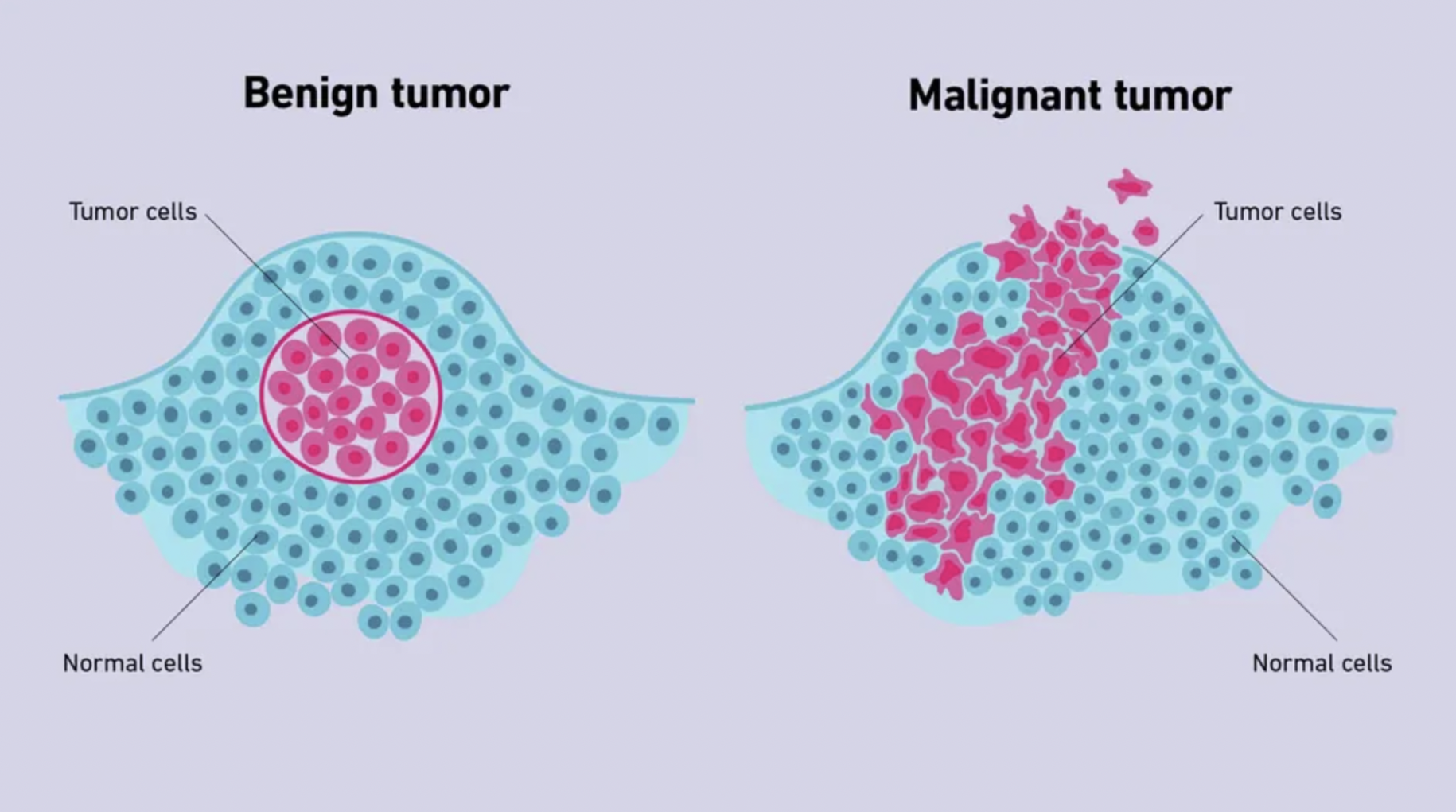
Figure 1: Benign tumors (left) are a slow growing collection of cells that are not invasive to normal cells. Malignant tumors (right) invade healthy tissue.
Malignant tumors are considered cancerous. Over time, tumors can grow larger, invade healthy tissues and even spread to other parts of the body (metastasize). If the cancerous cells spread, they can form new tumors, which can invade and destroy the cells in the surrounding healthy tissues elsewhere. Environmental and genetic factors determine whether a patient will develop benign or malignant tumors in his or her lifetime. It is possible for a benign tumor to transform to a more aggressive and malignant form.
Are Acoustic Neuromas Cancerous?
Knowing that an acoustic neuroma is a collection of abnormally grown cells may cause concern. However, there is good news. Acoustic neuromas are considered benign. They are not cancerous and do not spread to other parts of the body. These tumors can arise sporadically or with genetic mutations, such as a faulty gene on chromosome 22, which is responsible for regulating cellular growth within the myelin sheath of your nerves.
Patients with a hereditary condition called neurofibromatosis type 2 (NF2) are predisposed to acoustic neuromas. Those who have this condition often develop bilateral acoustic neuromas, which are tumors on both vestibulocochlear nerves. However, unilateral acoustic neuromas only affect one ear and comprise 95% of acoustic neuromas.
The transformation of a previously diagnosed benign acoustic neuroma to a malignant form is exceedingly rare, particularly in the absence of genetic factors such as NF2. There are a small handful of cases of sporadic (de novo) malignancies of the vestibulocochlear nerve. However, malignant tumors that form due to cancer are not typically acoustic neuromas.
How Could an Acoustic Neuroma Become Malignant?
While it is highly unlikely for an acoustic neuroma that a doctor diagnosed as benign to undergo a malignant transformation, it's not outside the realm of possibility. One of the treatment methods for acoustic neuromas is stereotactic radiosurgery, also called Gamma Knife, Cyberknife, etc. It's a precise method of delivering radiation therapy to the tumor to destroy the abnormal cells without harming the surrounding normal tissues. However, in extremely rare cases, it can be associated with acoustic neuroma malignancy.

Figure 2: Malignant transformation of acoustic neuroma years after stereotactic radiosurgery has been documented in the literature, however this is an extremely rare occurrence. Image credit: https://www.ncbi.nlm.nih.gov/pmc/articles/PMC3023338/
The risk of radiation-induced malignancy in acoustic neuromas is extremely minimal. However, there has been at least one case of an acoustic neuroma diagnosed as benign undergoing a malignant transformation in a recurrence following radiation therapy. With that said, the odds of developing an acoustic neuroma are extremely low, and the odds of an acoustic neuroma becoming malignant are even lower. Additionally, the risk of radiation-induced malignancy is heavily outweighed by the benefit the treatment offers.
What Are the Risks of Benign Acoustic Neuromas?
While an acoustic neuroma isn't malignant, it can still cause health problems. The common symptoms of an acoustic neuroma include:
- Hearing loss, usually in one ear
- Ringing, buzzing, humming, or clicking in the affected ear (tinnitus)
- A sensation of fullness in the ear canal
- Balance problems
Like any other tumor, acoustic neuromas have the potential to grow larger if untreated. The growth of an acoustic neuroma is slow and often takes years. The tumor can place pressure on other nerves and vital structures in the brain as it grows, causing more severe symptoms. So, benign acoustic neuromas still pose a risk to your health. In addition, surgery to remove smaller acoustic neuromas is often safer than waiting for them to get large before removing them.
Fortunately, the slow growth rate coupled with the fact that they are almost never cancerous means that handling a small non-symptomatic or minimally symptomatic acoustic neuroma often comes down to monitoring it. If an acoustic neuroma does grow, surgical or radiation options exist to treat it. The prognosis for an acoustic neuroma is generally favorable.
Concerned About Your Acoustic Neuroma Diagnosis?
A diagnosis of an acoustic neuroma can raise important questions about tumor growth, treatment, and long-term outlook. If you have been told that your tumor is growing, have experienced new symptoms, or want another expert opinion on your MRI and treatment options, Dr. Aaron Cohen-Gadol can review your case and discuss an individualized approach.
FAQs
What is the survival rate for someone with an acoustic neuroma?
Acoustic neuromas are usually benign, slow-growing tumors and are not generally considered life-threatening. With appropriate monitoring or treatment, most people have a favorable long-term outlook. However, the prognosis can vary depending on the tumor size, growth, symptoms, and the involvement of nearby nerves and brain structures.
Can an acoustic neuroma turn cancerous?
Acoustic neuromas are almost always benign and noncancerous. Malignant transformation is extremely rare. A tumor growing over time does not necessarily mean that it has become cancerous, as benign acoustic neuromas can also increase in size.
Acoustic neuromas are almost always benign and noncancerous. Malignant transformation is extremely rare. A tumor growing over time does not necessarily mean that it has become cancerous, as benign acoustic neuromas can also increase in size.
Personality changes are not a typical symptom of an acoustic neuroma. These tumors usually affect hearing, balance, and nearby cranial nerves. However, a large tumor can place pressure on surrounding brain structures and, in rare cases, may contribute to changes in behavior or other neurological symptoms.
Is an acoustic neuroma an emergency?
An acoustic neuroma is usually not a medical emergency because it typically grows slowly. However, sudden or severe symptoms such as significant neurological changes, difficulty walking, severe headache, facial weakness, or sudden changes in hearing should receive prompt medical evaluation. The urgency of treatment will depend on the tumor's size, growth, symptoms, and effect on surrounding structures.
Key Takeaways
- Acoustic neuromas are generally benign tumors of the eighth cranial nerve (vestibulocochlear nerve).
- Malignant acoustic neuromas are extremely rare.